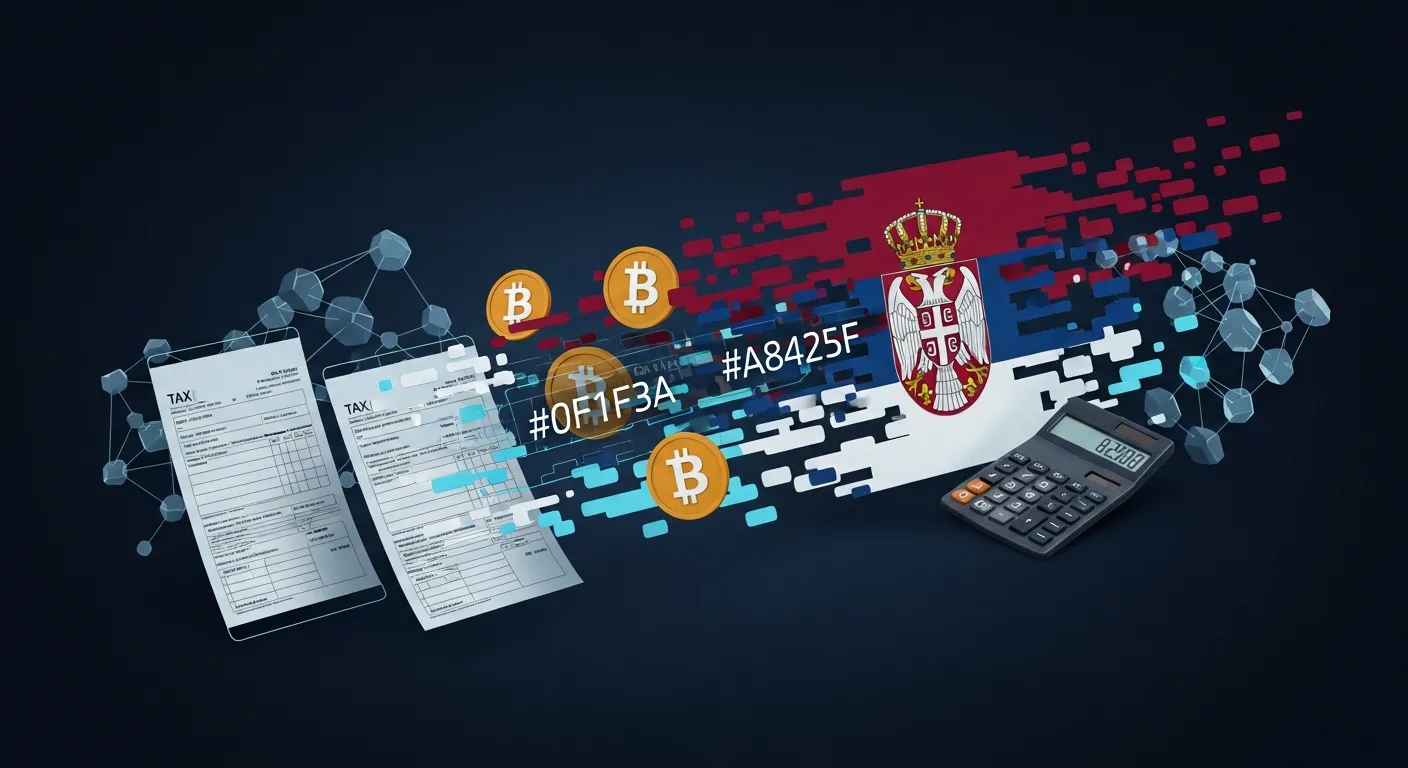
The tax treatment of digital assets in Serbia continues to raise numerous questions among natural persons, entrepreneurs and companies operating with cryptocurrencies. The Law on Digital Assets (Zakon o digitalnoj imovini — ZDI), adopted in 2020 (“Official Gazette of the RS” No. 153/2020, in force from 30 June 2021), along with amendments to tax legislation, has brought a degree of legal certainty, but has simultaneously opened new questions for which practice is still seeking answers. This text is informational in nature and does not substitute individual legal advice.
Legal Basis for the Taxation of Digital Assets
The taxation of digital assets in Serbia is regulated primarily by the Law on Personal Income Tax (Zakon o porezu na dohodak gradana) and the Law on Corporate Profit Tax (Zakon o porezu na dobit pravnih lica), with reference to the Law on Digital Assets (Zakon o digitalnoj imovini), which defines the concepts of virtual property and digital tokens.
The tax treatment of a specific transaction or activity depends on: – whether the taxpayer is a natural person, an entrepreneur or a legal entity; – the exact activities performed (buying and selling, mining, staking, DeFi operations); – whether the activity is of a business or non-business nature; – the basis on which the digital assets were acquired.
Correct classification of activities is crucial for determining tax liability, and the Tax Administration of the Republic of Serbia publishes guidelines and opinions that may assist in interpreting specific situations.
Capital Gains Tax for Natural Persons
A natural person who derives income from the sale or other disposal of virtual assets is subject to capital gains tax. In the Serbian tax system, capital gains on digital assets are taxed at the rate established by the applicable Law on Personal Income Tax. Capital gains are calculated as the difference between the selling price and the acquisition cost of the digital assets.
It is important to note that a capital loss from one transaction may be offset against a capital gain from another transaction in the same tax year, subject to the conditions prescribed by law. If a capital loss remains after offsetting, the law permits its carry-forward against future capital gains in the following five years, counting from the year in which the loss was incurred — provided, however, that losses may not be carried forward if the proceeds from the sale were invested in a manner prescribed by law in order to benefit from a tax exemption.
Precise and consistent recording of every transaction — date, value in dinars, acquisition cost — is not merely a recommendation, but a practical necessity for the correct calculation and reporting of taxes.
Mining and Staking — Special Tax Treatment
Income from cryptocurrency mining is treated differently from income from its sale. Mining involves generating new digital assets as a reward for participation in the process of verifying transactions on a blockchain network. From a tax perspective, the question is at which point taxable income arises — at the time the reward is generated, upon conversion into another currency, or upon final sale.
Serbian tax regulations and the practice of the Tax Administration in this area are evolving, and the specific interpretation may depend on the taxpayer’s particular tax status and the nature of the activity performed. Taxpayers who engage professionally in mining are generally required to register and tax these activities as a business activity.
The same applies to staking income — rewards for “committing” cryptocurrencies to the validation mechanisms of proof-of-stake networks. The tax treatment of such income requires careful legal consideration.
Taxation of Legal Entities
Companies that hold digital assets or conduct transactions with them are taxed under the Law on Corporate Profit Tax. Digital assets are recorded in business books at acquisition cost, and upon sale or other disposal, the difference in value is included in the tax base as income or an expense.
For companies registered as virtual asset service providers (VASPs; in Serbian: pružaoci usluga povezanih sa digitalnom imovinom — PUDI), the tax treatment of operating revenues is similar to that of revenues from regular business operations. Proper bookkeeping and compliance with International Financial Reporting Standards (IFRS) or applicable domestic standards is a prerequisite for the correct determination of tax liability.
VAT and Digital Assets
The application of value added tax (VAT) to digital asset transactions is one of the open questions of the Serbian tax system. In the EU, the judgment of the Court of Justice (C-264/14, Hedqvist) established that transactions involving the exchange of Bitcoin for legal tender are exempt from VAT. Serbian VAT legislation is developing independently, but it is possible that it will follow the development of EU practice.
Various services within the crypto ecosystem — such as exchange fees, custody services or consultancy services — may have a different VAT treatment from actual digital asset buy-and-sell transactions. Each business model requires separate analysis.
Record-Keeping and Reporting Obligations
Regardless of the level of income, accurate recording of all digital asset transactions is of essential importance. The Tax Administration may request access to transaction records, exchange statements and appropriate documentation for each purchase, sale or other transaction.
Natural persons who realise a capital gain are required to declare it through the relevant tax return. Failure to report a tax liability may result in subsequent determination of the tax by the Tax Administration, with the application of statutory interest and potential penalties.
Frequently Asked Questions (Q&A)
Do I have to pay tax if I bought and held cryptocurrencies without selling? The mere act of purchasing and holding digital assets (the HODL strategy) does not, in principle, generate a tax liability. A taxable event on capital gains grounds arises at the time of sale or other disposal of the digital assets.
What if I lost access to my wallet or my digital assets were stolen? Loss due to theft or technical problems complicates the tax treatment. Depending on the specific circumstances and the taxpayer’s tax status, recognition of the loss may be considered. These situations require specific tax and legal analysis.
How is the exchange of one cryptocurrency for another taxed? In many jurisdictions, including the tendencies in Serbian practice, the exchange of one virtual asset for another (Bitcoin for Ether) is treated as a taxable event, rather than as a deferred taxation. The specific transaction requires individual tax analysis.
Is there a de minimis threshold below which I do not have to report income from cryptocurrencies? Serbian tax law does not provide for an explicit de minimis threshold for income from digital assets that would be automatically exempt from taxation. Every capital gain is, in principle, subject to reporting.
Conclusion
The tax treatment of digital assets in Serbia is a dynamically developing area, and failure to meet tax obligations may have serious legal and financial consequences. Proactive planning and timely assessment of obligations generally reduces the risk of subsequent tax assessments, interest and penalties.
For an assessment of specific tax obligations in the field of digital assets, it is advisable to obtain individual legal and tax advice.
Sources: – https://www.purs.gov.rs/aktuelnosti/poreska-uputstva/904/oporezivanje-digitalne-imovine-srbija.html – https://www.mfin.gov.rs/ – https://www.paragraf.rs/propisi/zakon_o_porezu_na_dobit_pravnih_lica.html – https://curia.europa.eu/juris/document/document.jsf?docid=170305&doclang=EN