The market for non-fungible tokens (NFTs) has experienced explosive growth, bringing new opportunities for digital artists, collectors, and investors. In that enthusiasm, however, a fundamental legal aspect has often been overlooked: the purchase of an NFT and the acquisition of copyright in the artistic work that the token “represents” are two distinct legal matters. This misconception is the source of numerous disputes and disappointments in the NFT market. This text is for informational purposes only and does not substitute individual legal advice.
What Is an NFT and What Are You Actually Buying
An NFT (Non-Fungible Token) is a unique cryptographic record on a blockchain network that confirms ownership and authenticity of a specific digital asset. Unlike fungible tokens such as Bitcoin (where each unit is identical to another), each NFT is unique and non-fungible.
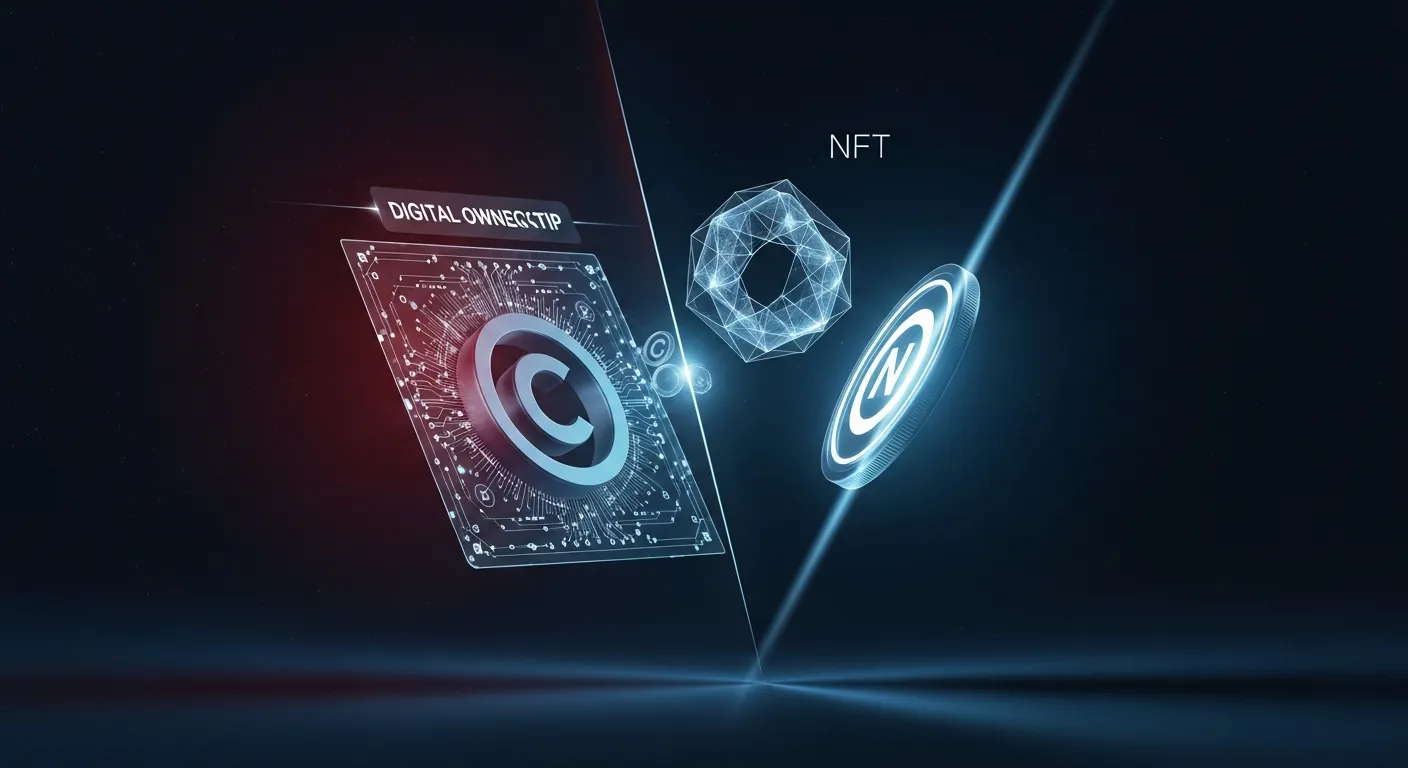
What is actually acquired through the purchase of an NFT is ownership of that specific digital item on the blockchain — that is, of the record pointing to particular content (most commonly an image, video, music, or another digital file). However, the digital file to which the NFT refers is usually not stored on the blockchain itself, but on an external server or an IPFS (InterPlanetary File System) network. Ownership of an NFT does not automatically entail: – transfer of copyright in the work; – an exclusive right to reproduce or distribute the work; – the right to make commercial use of the visual content; – the right to prohibit others from viewing or sharing the image.
Copyright under Serbian and International Law
Copyright arises automatically, by the very act of creating an original work, and vests in the author without any need for registration. The Law on Copyright and Related Rights of the Republic of Serbia (Zakon o autorskom i srodnim pravima) — as well as comparable legislation and the Berne Convention — protects the author and grants exclusive rights to reproduce, distribute, publicly display, and adapt the work.
The transfer of economic copyright under Serbian law must, as a rule, be explicit and in written form in order to be valid — the Law on Copyright and Related Rights prescribes the written form for copyright agreements, unless the law provides otherwise. If the agreement for the sale of an NFT does not contain an explicit clause on the transfer of copyright, those rights remain with the author, regardless of the price paid for the NFT.
In cases of copyright infringement in the NFT context, protection is sought before the competent courts, while the Intellectual Property Office of the Republic of Serbia (Zavod za intelektualnu svojinu) — the body responsible for intellectual property matters — enables, among other things, the deposit of copyrighted works, which may serve as evidence of authorship.
Typical Licensing Models in NFT Markets
Practice on leading NFT marketplaces (OpenSea, Foundation, Rarible, etc.) varies, but broadly speaking, several models exist:
1. No Transfer of Rights — The buyer receives the token and a personal right of use for non-commercial purposes. The author retains all economic copyright. This is the most common model.
2. Limited Commercial Licence — The buyer receives the right to certain commercial uses (e.g., printing on T-shirts up to a specified print run). The terms are set out in the platform’s rules or in a separate licence.
3. CC0 (Creative Commons Zero) — The author waives all copyright and places the work in the public domain. Anyone may use the work in any manner. This model was popularised by collections such as Nouns.
4. Full Transfer of Copyright — Rare, but possible. The buyer acquires all of the author’s economic rights. Such a transfer must be explicit, in writing, and specific.
For buyers, it is important to carefully review the platform’s terms of use and, where one exists, the specific licence attached to the NFT before purchasing.
Copyright Infringement and Fraudulent NFT Minters
One of the most common problems in the NFT market is the “minting” of NFTs by persons who are not the authors of the work. Someone may take another person’s photograph or artwork, create an NFT, and sell it — without the actual author’s consent and without providing any compensation.
From a legal standpoint, such an action constitutes copyright infringement, regardless of the fact that the transaction is recorded on the blockchain. A blockchain record does not legitimise the unlawful appropriation of another person’s work. The author may demand the removal of the disputed NFT from the platform, claim damages, and, in certain circumstances, pursue the infringer’s criminal liability.
NFT platforms operating in the EU are increasingly required to respond to such requests under the regulations on the liability of digital platforms.
Protecting Authors in the Web3 Ecosystem — Practical Considerations
For artists considering entering the NFT space:
- Before minting, clearly define which rights are being sold with the NFT — in a manner visible to the buyer.
- Standardised open licences (Creative Commons) or a legally clear attachment accompanying each NFT reduce the scope for disputes.
- “Royalty” mechanisms can automatically direct a percentage of each subsequent sale to the original author.
- Documenting authorship of the work before minting (date of creation, drafts, metadata) facilitates proof in any potential dispute.
For buyers: – It is important to verify who the NFT minter is and whether they are in fact the author or an authorised distributor. – The licence accompanying the NFT determines the scope of permitted use — its content governs, not the purchase price. – Commercial projects that presuppose a transfer of rights not expressly stated carry increased legal risk.
Frequently Asked Questions (Q&A)
Does purchasing an expensive NFT give me the right to use the image for commercial purposes? Not automatically. The right of commercial use must be explicitly stated in the licence or agreement accompanying the NFT. A high purchase price alone does not transfer copyright.
What can I do if someone mints my artwork as an NFT without my permission? You may submit a takedown request (DMCA — Digital Millennium Copyright Act — takedown, or the equivalent procedure under EU law) directly to the platform, initiate proceedings with a claim for damages before the competent court, or seek an interim measure to block the disputed NFT.
Can an author’s copyright be “lost” if their work has already been minted without permission and sold? No. Unauthorised minting and sale of an NFT does not transfer or extinguish the original author’s copyright. The author retains all rights even if another person created the token.
How do royalties work in the NFT world? Many blockchain networks and platforms enable the automatic transfer of a portion of the proceeds of each subsequent sale to the original author (so-called on-chain royalties). However, these mechanisms are not always technically mandatory and can be circumvented on some platforms, which remains an active topic of discussion in the Web3 community.
Conclusion
The purchase of an NFT is a more complex legal transaction than it may appear at first glance. A clear distinction between the token and intellectual property is the foundation for a healthy and sustainable NFT market ecosystem — for both authors and buyers. For specific situations — such as launching an NFT collection or protecting copyright in the digital space — each licence and each agreement requires separate legal analysis.
Sources: – https://www.wipo.int/wipo_magazine/en/2021/04/article_0007.html – https://www.zis.gov.rs/pravni_propisi/zakoni.html – https://www.paragraf.rs/propisi/zakon_o_autorskom_i_srodnim_pravima.html – https://op.europa.eu/en/publication-detail/-/publication/3a239b0a-0498-11ed-a1d0-01aa75ed71a1/language-en