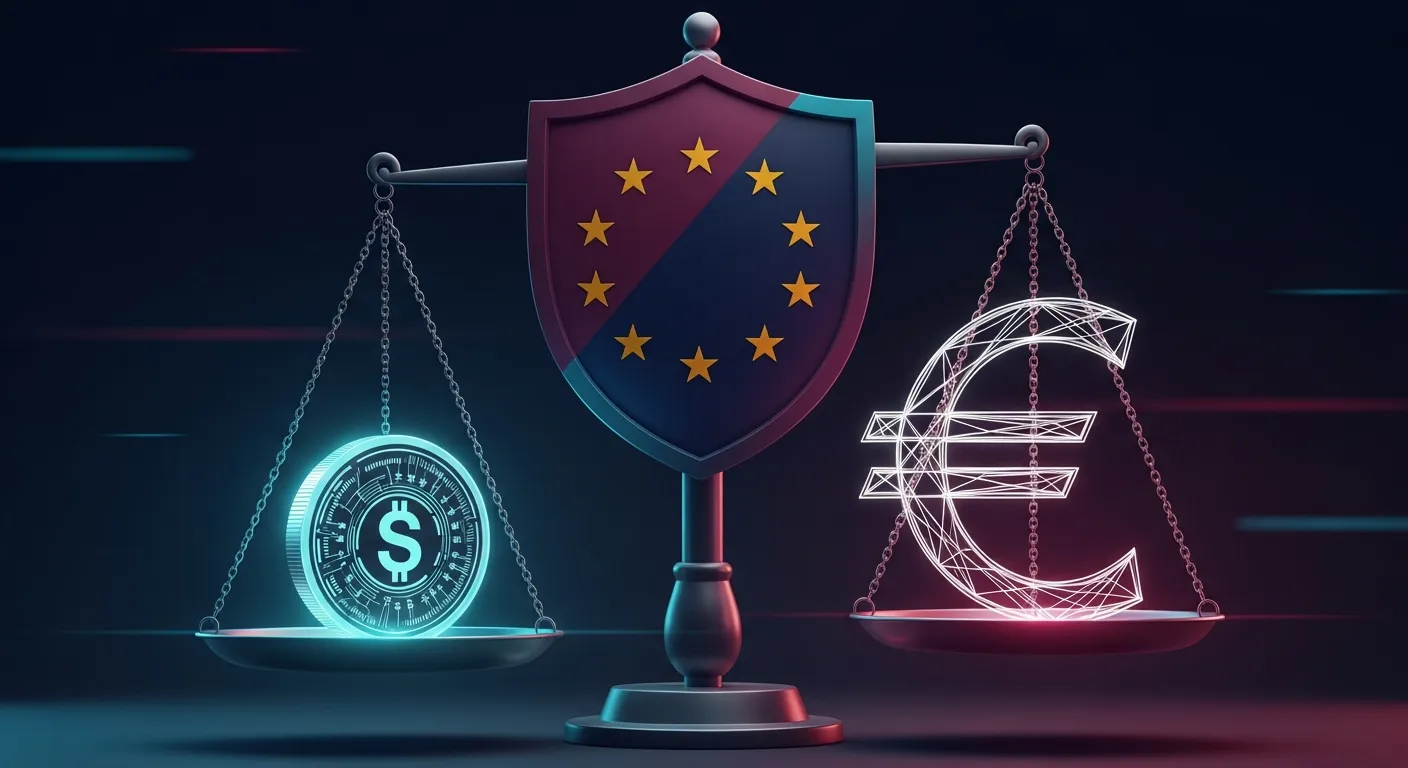
Stable cryptocurrencies — stablecoins — have become a cornerstone of the crypto economy, used for payments, value storage, DeFi transactions, and cross-border transfers. Unlike Bitcoin or Ether, whose prices fluctuate, stablecoins are designed to maintain a stable value relative to a reference asset, most commonly the US dollar or the euro. Precisely because of their systemic role, the European Union, through MiCA (the Markets in Crypto-Assets Regulation, Regulation (EU) 2023/1114), has developed one of the most detailed regulatory frameworks in the world for this type of crypto-asset. This text is informational in nature and does not replace individual legal advice.
Stablecoin Categories Under MiCA
MiCA classifies stablecoins into two regulatory categories, each carrying a specific set of obligations:
1. Asset-Referenced Tokens (ART) — tokens whose value is pegged to a basket of assets: multiple fiat currencies, commodities (gold, oil), or combinations of crypto-assets. The objective is stability through diversification. A classic example that prompted the creation of this framework was Meta’s original Libra project (the basket version from 2019, pegged to multiple currencies).
2. E-Money Tokens (EMT) — tokens pegged to the value of a single fiat currency (EURC pegged to the euro, or USDC to the dollar). These tokens functionally resemble electronic money and are regulated under rules similar to those applicable to traditional electronic money institutions.
A third, broader category consists of “other crypto-assets” that do not fall under ART or EMT, but these are also subject to MiCA’s general provisions when circulated in the EU.
Requirements for ART Issuers
Issuers of Asset-Referenced Tokens must be authorised by the competent authority of the EU Member State in which they have their registered office. Authorisation is not a one-way process — it entails ongoing compliance with extensive regulatory requirements.
Key requirements for ART issuers under MiCA:
- Reserve fund: Full coverage of the value of issued assets by highly liquid reserves. Reserves must be segregated from the company’s own assets and held separately in the interest of token holders.
- Reserve management: Strict rules on allocation, investment, and liquidity of the reserve fund.
- Right of redemption: ART token holders must at all times have the right to redeem their tokens — either by payment in monetary funds equivalent to the market value of the reference assets, or by delivery of the reference assets themselves — in principle at no charge, with MiCA permitting the establishment of redemption conditions (thresholds, periods, deadlines).
- Transparency: Mandatory publication of a white paper — a document describing in detail the token, the reserve mechanism, and the rights of the holder.
- Usage restrictions: For “significant” ART tokens (those that exceed a certain threshold of acceptance or market capitalisation), MiCA introduces additional restrictions and direct supervision by the EBA (European Banking Authority), in cooperation with ESMA (European Securities and Markets Authority).
Requirements for EMT Issuers
E-Money Tokens are subject to a distinct regulatory regime because they are functionally close to electronic money. An EMT issuer must be either a credit institution or an electronic money institution holding the appropriate licence in one of the EU Member States.
This is a particularly important provision, as it effectively excludes firms that do not hold such a licence from legally issuing a stablecoin pegged to the euro or another EU currency, without first registering as an EMI (Electronic Money Institution). For companies outside the EU wishing to issue EUR-pegged tokens for the EU market, this requires the establishment of a regulated entity within the EU.
Systemic Risks and Enhanced Supervision of “Significant” Stablecoins
MiCA distinguishes between “standard” and “significant” ARTs and EMTs. A token is classified as “significant” if it exceeds certain thresholds in terms of number of users, transaction value, market capitalisation, or acceptance as a means of payment. The criteria for “significance” are set out in the MiCA text, and the precise rules are established and reviewed by the EBA.
“Significant” tokens are brought under the direct supervision of the European Banking Authority (EBA), in cooperation with ESMA, rather than the national regulator. This reflects concerns that large stablecoins could affect the monetary stability and financial system of the EU as a whole.
Consumer Protection as the Foundation of Regulation
The protection of stablecoin holders is one of MiCA’s central objectives. Specifically:
- The right to redeem tokens at no charge, which MiCA guarantees to holders, protects users against de-pegging scenarios.
- The obligation to segregate reserves protects users in the event of the issuer’s insolvency.
- Transparent information in the white paper helps users make informed decisions.
- The prohibition on paying interest on stablecoins is a MiCA provision that controversially limits the attractiveness of these instruments, but prevents their use as a substitute for a bank deposit.
Implications for Serbia
Serbia is not a member of the EU and is not directly bound by MiCA. However, any Serbian company wishing to issue a stablecoin for the EU market or to provide services related to EU stablecoins must either establish an EU-regulated entity or refrain from targeting EU users.
The Serbian Law on Digital Assets (Zakon o digitalnoj imovini) does not contain provisions equivalent to MiCA’s stablecoin regulation. As EU integration negotiations progress, future harmonisation of domestic legislation with MiCA standards can be expected, though the timeline remains uncertain.
Frequently Asked Questions (Q&A)
Do USDT (Tether) and USDC meet MiCA requirements? Both tokens have attracted regulatory attention in the EU. USDC is issued by Circle, which is actively positioning itself for MiCA compliance. Tether has long been under question regarding reserve transparency. Official information on the status of specific stablecoins is published by the competent regulators.
Can a Serbian company legally use stablecoins for business purposes? Using stablecoins for internal business purposes or transactions between Serbian legal entities is not prohibited in Serbia, but it carries tax and accounting implications. However, providing stablecoin-related services to EU users without the appropriate MiCA authorisation entails regulatory risk.
What does “de-pegging” mean and what are the legal risks? De-pegging is the loss of a stablecoin’s peg to its reference value, which can result in losses for holders. MiCA seeks to minimise this risk through reserve requirements and the right of redemption. For users, legal remedies in the event of de-pegging depend on whether the issuer is MiCA-compliant and whether the right of redemption was formally guaranteed.
Can an EMT pay interest to users? Not under MiCA. The prohibition on paying interest on e-money tokens is an explicit MiCA provision, based on the principle that an EMT must not function as a bank deposit. This is particularly relevant for DeFi protocols that offered yield on stablecoin deposits.
Conclusion
MiCA’s regulation of stablecoins is comprehensive, technically demanding, and sets high standards for any party wishing to operate in the EU crypto market. For companies considering issuing stablecoins or providing services related to this type of asset, timely compliance is a prerequisite for sustainable operations.
Schedule a consultation and let us assess together how MiCA affects your business model.
Sources: – https://eur-lex.europa.eu/legal-content/EN/TXT/?uri=CELEX:32023R1114 – https://www.eba.europa.eu/regulation-and-policy/crypto-assets/mica-implementing-rules – https://www.ecb.europa.eu/pub/pdf/scpops/ecb.op308~61842065f4.en.pdf