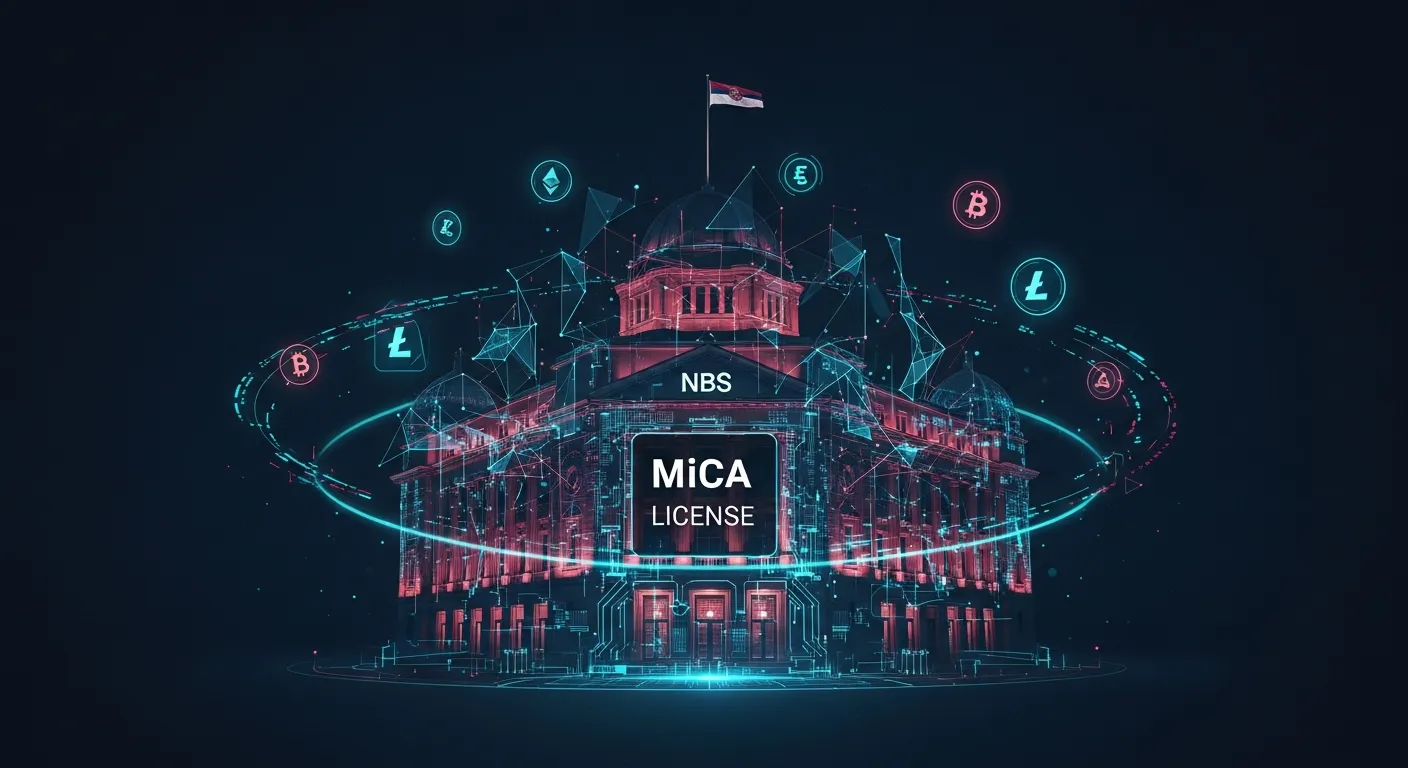
As of 30 December 2024, the MiCA Regulation (EU Regulation 2023/1114) applies in full to all crypto-asset service providers offering services to EU citizens. Serbia is not an EU member state, but companies targeting the European market — or seeking to attract European capital — cannot ignore this framework. At the same time, the domestic Law on Digital Assets of 2020 and the supervisory role of the National Bank of Serbia (NBS) define what it means to operate lawfully in the Serbian market. This text is informational in nature and does not replace individual legal advice.
What MiCA Is and Who It Concerns
MiCA (Markets in Crypto-Assets Regulation) is the EU regulatory framework that introduces licensing for crypto-asset service providers (CASPs). The CASP categories include: exchange platforms, custody services, placement of crypto-assets, advisory services, and transfer of assets.
Every company established in the EU that provides any of these services must obtain a licence from the competent authority of its home member state. Companies outside the EU that target EU customers are subject to reverse solicitation rules — the exemption is narrow and should not be treated as a reliable escape from the licensing obligation.
The NBS as the Competent Authority in Serbia
In Serbia, the Law on Digital Assets (ZDI — “Official Gazette of the Republic of Serbia” No. 153/2020) established the National Bank of Serbia (NBS) and the Securities Commission (KHoV) as a dual supervisory body. The NBS licenses providers of digital-asset-related services (PUDI) that carry out exchange and custody activities; the KHoV covers instruments that resemble securities.
Registered PUDIs in Serbia must satisfy requirements that are structurally close to MiCA, but are not identical. The harmonisation of Serbian law with MiCA is ongoing; the precise deadline and scope of amendments to the ZDI had not been definitively confirmed at the time of publication of this text.
CASP Categories and Capital Requirements under MiCA
MiCA introduces three levels of capital requirements, depending on the class of CASP:
- Class 1 (advisory services, transfer of assets): minimum capital EUR 50,000
- Class 2 (exchange of crypto-assets for fiat currency): EUR 125,000
- Class 3 (multilateral trading platform): EUR 150,000
In addition to capital, CASPs are required to maintain: a risk management policy, a business continuity plan, professional indemnity insurance or an equivalent guarantee, and clear segregation of client assets.
Registration and Authorisation Procedure
The licensing procedure under MiCA is submitted to the competent authority of the home EU member state and includes:
- Submission of the application with complete documentation (programme of activities, organisational chart, information on beneficial owners, AML/CFT policies)
- Assessment of the application — the regulatory authority has 25 working days to confirm the completeness of the documentation, and then 40 working days from the complete application for a decision on the merits (the decision is communicated within 5 working days of being taken)
- Issuance of authorisation — valid across the entire territory of the EU (the “EU passport” for CASPs)
For Serbian companies that do not plan to use an EU passport but wish to operate in the domestic market, the relevant procedure is that before the NBS under the ZDI.
Compliance Deadlines and Transitional Period
MiCA provided for a transitional period for CASPs that were already operating lawfully in their home member state before 30 December 2024. This period is up to 18 months from the date of application in certain member states, but it is not automatic — it depends on whether the home EU member state made use of this option and under what conditions.
Companies starting a business from scratch in 2026 have no transitional period — the licence must be obtained before services are provided to EU customers.
Consequences of Non-Compliance
Providing CASP services to EU customers without authorisation may result in:
- A prohibition on providing services and a market ban in the EU
- Financial penalties (MiCA provides for administrative fines of up to EUR 15 million or a percentage of annual turnover for legal entities — the exact maximum depends on the type of infringement)
- Reputational harm and loss of investor confidence
- Criminal and misdemeanour liability under domestic law (the ZDI provides for penalties for natural persons as well)
Frequently Asked Questions (Q&A)
Does a Serbian company need a MiCA licence? A Serbian company that exclusively provides services in the Serbian market is not directly subject to MiCA, but must be registered with the NBS under the ZDI. If it targets EU customers, a MiCA licence in one of the EU member states or a reverse solicitation analysis becomes necessary.
What is the minimum capital for a crypto exchange in the EU under MiCA? For an exchange platform (Class 2), the minimum initial capital is EUR 125,000, along with mandatory professional indemnity insurance.
How long does the authorisation procedure take under MiCA? From the completion of the documentation, the competent authority has up to 40 working days for a decision on the merits. Preparation of the documentation typically takes 2–6 months, depending on the complexity of the company.
Can a Serbian founder obtain a MiCA licence? Yes, but the company must have its registered office in one of the EU member states. Serbia is not in the EU, so a Serbian company cannot apply directly for a MiCA licence — it must establish an EU entity.
Conclusion
MiCA and the Serbian ZDI together lay down clear rules for crypto business. The key step for any company is the accurate classification of its services, an assessment of the target market, and compliance before regulators come knocking.
If you are planning to launch a crypto exchange, a custody platform, or any other CASP model — consult a lawyer before making structural decisions.
Sources: – Regulation (EU) 2023/1114 of the European Parliament and of the Council of 31 May 2023 (MiCA) – Law on Digital Assets of the Republic of Serbia, “Official Gazette of the Republic of Serbia” No. 153/2020 – NBS — Digital Assets: https://www.nbs.rs/sr_Latn/finansijske_institucije/digitalna_imovina/